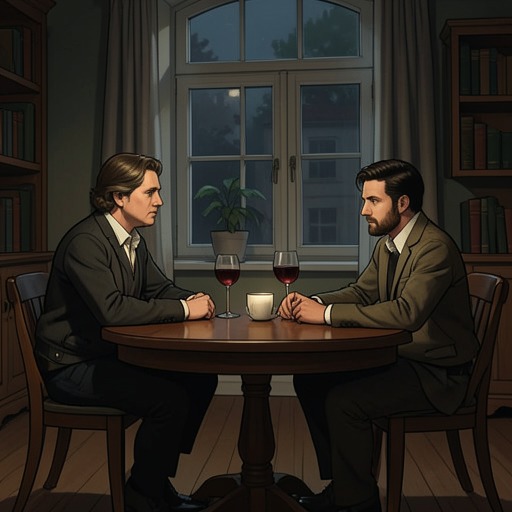
Jo and David’s marital alienation
The ForgivenJo and David’s marital alienation is not presented as the simple disappearance of affection. It gathers around a journey David is about to make: Jo resents him, sees his guilt differently from her own, and nonetheless packs his belongings, while David leaves with a measure of relief and later recognizes her unhappiness as part of the bond that keeps them connected. Their distance is real, but care and attachment persist within it.
Identity and Circumstances
The strain between Jo and David is shaped by the aftermath of Driss’s death and by the demand that David accompany Driss’s body. Jo’s thoughts reveal resentment that has become difficult to distinguish from exhausted love. She considers whether she truly hates David, then understands her hostility as bound up with having let him into her life and feeling that he failed to meet what she expected of him. Her account is not a settled judgment so much as an argument she makes to herself: she casts David as the one who blusters and bullies, and assigns the greater moral fault to men rather than women.
That division of blame matters because David’s inward account is almost its inverse. Looking at the melting ice in his whisky, he thinks that the fault is his and that going may be for the best. Jo interprets the marital injury through his pride and his failures; David places responsibility on himself. Their estrangement thus includes not only hurt but a mismatch in how each understands its source. Neither account fully resolves what has happened between them.
Departure and the Work of Care
When David says he is leaving soon, Jo announces that she will go with him. The offer briefly makes the separation seem reversible, but David tells her that Abdellah has forbidden women to accompany them and says she would complicate the journey. Jo tries to argue, then lets the effort fade. She recognizes that she does not, after all, want to go. Her response includes a sad, almost triumphant sense that it is right for David to leave, even as she worries about him.
Jo then packs his shaving bag and sports bag carefully, putting in toiletries, a toothbrush, razors, vitamin pills, cotton balls, and folded clothes. The practical precision of this task gives their separation an intimate domestic form: she prepares him to leave as if sending a child away to school. For a moment, she presses a knuckle into her mouth as tears rise. The grief, as she understands it, is not chiefly for David’s immediate safety but for their shared past, which seems to have vanished. Her care does not cancel her resentment, and her reluctance to accompany him does not make the parting emotionally easy.
David, for his part, admits that he is relieved to go. He imagines crossing a bridge and getting past a number of unresolved matters, while also describing the journey as a gesture of solidarity and an occasion to say he is sorry. His departure therefore has two meanings at once: it is an obligation connected to Driss’s death, and an escape from the pressure of things between himself and Jo. The evidence presents both motives together rather than reducing the journey to either self-punishment or marital flight.
Absence, Work, and Feeling Unneeded
While David is away, Jo’s sense of estrangement extends beyond the marriage. In the pool at the party, she thinks about her abandoned writing, the books she fears will be forgotten, and the possibility that she has nothing more to say. She can imagine silence as a relief as well as a failure; not being needed, she reflects, can have its own pleasure. This meditation does not explain the marriage, but it places Jo’s marital loneliness beside a broader uncertainty about her work, visibility, and value to others.
That uncertainty is made concrete by David’s absence. He has not answered five calls on his cell phone. Jo’s attention returns to the party and to the younger women there, as she wonders whether she is less beautiful or less able to inhabit the present. The unanswered calls do not establish what David intends, but they leave Jo alone with the questions raised by his departure. Her anxiety and guilt are unresolved; she has no clear person from whom to seek forgiveness while David is occupied with Abdellah.
Fidelity and the Continuing Bond
During his confinement, David imagines Jo at the party, perhaps standing by herself and trying to make each minute pass. These are his conjectures, not a report of what she is actually doing. He knows her as someone who is not much of a partygoer and imagines her unhappiness as repetitive. His reflection is revealing because he initially describes that repetition as a limitation, then recognizes that it is also part of what he loves about her.
David considers whether he would love her less if she were using cocaine and concludes that he would: in his view, forgetting him at this moment would feel like a betrayal. He instead reads her unhappiness and persistence as signs of fidelity. The same quality that makes him see her as stuck also reassures him that she remains attached to him. Their bond is therefore neither repaired nor severed in these passages. The account says they have made a profound decision, but does not specify its terms; what it does show is that neither simply cuts the knot between mutinous unhappiness and attachment.
Narrative Significance
The marriage is rendered through contrasting acts of interpretation rather than a decisive confrontation. Jo’s careful packing and grief for the past sit beside her conviction that David bears the greater fault. David’s willingness to leave and his wish to cross a bridge sit beside his renewed appreciation of Jo’s fidelity. Their alienation is consequential precisely because ordinary gestures and imagined habits continue to carry intimacy: the packed toothbrush, the unanswered calls, and David’s expectation that Jo will remain unhappy rather than forget him. The relationship remains unsettled, held between blame and care, distance and a bond neither character is shown cutting.